Flowers Laboratory
FLOWing Epigenetic Robots and Systems
Scientific Overview
The Flowers team studies mechanisms that can allow robots and humans to acquire autonomously and cumulatively repertoires of novel skills over extended periods of time. This includes mechanisms for learning by self-exploration, as well as learning through interaction with peers. We are interested in both the acquisition of sensorimotor and interactive skills. Sensorimotor skills include locomotion, affordance learning, active manipulation. Interactive skills include grounded language use and understanding, adaptive interaction protocols, and human-robot collaboration.
Rather than trying to imitate the intelligence of adult humans, we follow an idea formulated sixty years ago by Alan Turing, but that really began to be explored at the beginning of the 21st century: we try to reconstruct the processes of human cognitive development in robots, rooted in the dynamical interactions between its brain, its body and its environment, and use this constructive approach to advance our understanding of child development. This approach is called developmental robotics, or epigenetic robotics, and imports concepts and theories from developmental sciences, in particular developmental psychology, developmental and cognitive neuroscience, biology and linguistics.
The general hypothesis is that such an approach shall set the stage for new kinds of mechanisms allowing robots and machines to be much more robust when faced with unknown spaces and tasks that are not always known in advance by the engineer(s) who conceive them. Moreover, operationalizing and implementing developmental sciences theories gives in return the opportunity to test empirically their internal coherence.
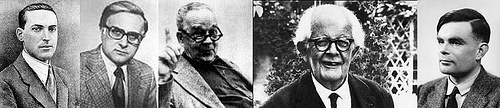
From left to right: Lev Vygotsky and his concept of zone of proximal development, Daniel Berlyne and his theory of intrinsic motivation and curiosity, J.J. Gibson and his concept of affordances, Jean Piaget and his seminal studies on the developmental trajectories of human children, inform research in developmental robotics and computational developmental sciences. On the right, Alan Turing, who was already advocating in his Computing machinery and intelligence; paper in 1950 that for building a that could think like humans, one should try to “simulate the mind of the child” instead of the mind of the adult.
A significant challenge we study is that such robot learning and development must happen in large, high-dimensional, unbounded and partially unlearnable continuous sensorimotor spaces, especially through the interactions of the body with external objects and persons. At the same time, robots are severely limited by their life-time and can afford neither exploring randomly nor learning skills from tabula-rasa and unconstrained algorithms.
The central insight, based on infant development, is that such robust, versatile and flexible learning in the real-world can only become possible within certain families of developmental mechanisms and constraints, which are mechanisms allowing to actively control and bias the growth of complexity in exploration and learning. Vice versa, these developmental mechanisms will bias the learner towards certain families of skills, rather than others. Infants are not universal learners due to these constraints. Because of this, we take inspiration from early infant developmental constraints, and the kinds of skills that we would like our robots to learn will be similar to those infants learn in their first year of life, i.e. discovery and learning of their own body, learning of new basic affordances with new objects (i.e. learning new motor programs and their effects on specific kinds of objects, such as pushable/rollable/soundable/throwable), discovering primary visual or auditory concepts such as proto-objects and phonemes, learning the basic elements of language (i.e. learning to associate new acoustic words with new relatively simple meanings). Thus, we do not target to build machines with human adult-level intelligence, which should only be considered after we have a good understanding of how young infant capabilities can be formed.
Among the developmental principles that characterize human infants and can be used to guide robot learning and development, FLOWERS focuses on the following three principles:
- Exploration is progressive. The space of skills that can be learnt in real world sensorimotor spaces is so large and complicated that not everything can be learnt at the same time. Simple skills are learnt first, and only when they are mastered, new skills of progressively increasing difficulty become the behavioural focus;
- Internal representations are (partially) not innate but learnt and adaptive. For example, the body map, the distinction self/non-self and the concept of “object” are discovered through experience with initially uninterpreted sensors and actuators;
- Exploration can be self-guided and/or socially guided. On the one hand, internal and intrinsic motivation systems regulate and organize spontaneous exploration; on the other hand, exploration can be guided through social learning and interaction with caretakers.
- Exploration is fundamentally constrained by embodiment, in particular morphological and maturational constraints.
Based on these principles, our research projects are investigating the following topics:
-
Intrinsic motivation, active learning and maturation for guided learning
Intrinsic motivations are mechanisms that are key for internally guiding robots to collect autonomously and efficiently their own learning data. Our first objective is to formalize, study and evaluate them as a form of active learning: by driving the learner to explore in areas where he empirically makes a maximum amount of learning progress, this allows fast, frugal and efficient learning in high-dimensional inhomogeneous sensorimotor spaces. A related objective is to study maturation as a set of complementary mechanisms that progressively liberate novel degrees of freedom, and increase spatio-temporal resolution, useful in very large spaces. Intrinsic motivation and maturation allow to drive the autonomous collection of data which is used by learning algorithms elaborated in Topic 2 to build world or skill models. We are also studying how intrinsic motivation and active learning can be used in combination with social learning mechanisms elaborated in Topic 3. Finally, spaces in which guided exploration takes place could be themselves learnt through autonomous perceptual and representation learning mechanisms studied in Topic 4. -
Cumulative learning, reinforcement learning and optimization of autonomous skill learning: FLOWERS develops machine learning algorithms that can allow embodied machines to acquire cumulatively sensorimotor skills. In particular, we develop optimization and reinforcement learning systems which allow robots to discover and learn dictionaries of motor primitives, and then combine them to form higher-level sensorimotor skills.
-
Social learning and human-robot interaction: Social learning mechanisms allow robots to learn (or teach) while interacting socially, naturally and intuitively with non-engineer humans. Our objectives are manifold:
- 1) Elaborate intuitive and adaptive human-robot interfaces for efficient learning and teaching;
- 2) Elaborate learning mechanisms that allow the robot to interpret and use the guidance hints provided by the human to teach new skills;
- 3) Study the combination of social and autonomous learning mechanisms as elaborated in Topics 1 and 2;
- 4) Apply learning through interaction to interaction learning, where the robot learns interactive skills such as elements of language.
- Autonomous perceptual and representation learning: In order to harness the complexity of perceptual and motor spaces, as well as to pave the way to higher-level cognitive skills, developmental learning requires abstraction mechanisms that can infer structural information out of sets of sensorimotor channels whose semantics is unknown, discovering for example the topology of the body or the sensorimotor contingencies (proprioceptive, visual and acoustic). This process is meant to be open- ended, progressing in continuous operation from initially simple representations towards abstract concepts and categories similar to those used by humans. Our work focuses on the study of various techniques for:
- 1) autonomous multimodal dimensionality reduction and concept discovery;
- 2) incremental discovery and learning of objects using vision and active exploration, as well as of auditory speech invariants;
- 3) learning of dictionaries of motion primitives with combinatorial structures, in combination with linguistic description;
- 4) active learning of visual descriptors useful for action (e.g. grasping);
-
Embodiment and maturational constraints: FLOWERS studies how adequate morphologies and materials (i.e. morphological computation), associated to relevant dynamical motor primitives, can importantly simplify the acquisition of apparently very complex skills such as full-body dynamic walking in biped (see our Acroban project). FLOWERS also studies maturational constraints, which are mechanisms that allow for the progressive and controlled release of new degrees of freedoms in the sensorimotor space of robots.
-
Discovering and abstracting the structure of sets of uninterpreted sensors and motors: FLOWERS studies mechanisms that allow a robot to infer structural information out of sets of sensorimotor channels whose semantics is unknown, for example the topology of the body and the sensorimotor contingencies (propriocetive, visual and acoustic). This process is meant to be open-ended, progressing in continuous operation from initially simple representations to abstract concepts and categories similar to those used by humans.
Address in Bordeaux
Inria Bordeaux Sud-Ouest
200, avenue de la vieille tour
33405, Talence
France
Address in Paris

U2IS
ENSTA ParisTech
828, bd des Maréchaux
91762 PALAISEAU CEDEX
France
Institutions