Home
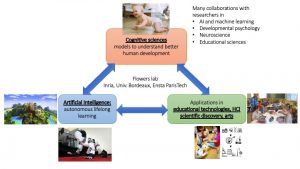
Can a robot learn like a child? Can it learn new skills and new knowledge in an unknown and changing environment? How can it discover its body and its relationships with the physical and social environment? How can it discover language through natural interactions with humans? How can its cognitive capacities continuously develop without the intervention of an engineer once it is "out of the factory"?
These are the questions that we are investigating in the FLOWERS research team at INRIA Bordeaux Sud-Ouest and ENSTA-Paristech in Paris. Rather than trying to imitate the intelligence of adult humans like in the field of Artificial Intelligence, we follow an idea formulated sixty years ago by Alan Turing, but that really began to be explored at the beginning of the 21st century: we try to reconstruct the processes of development of the child's mind, rooted in the dynamical interactions between its brain, its body and its environment. This approach is called developmental robotics, or epigenetic robotics, and imports concepts and theories from developmental sciences, in particular developmental psychology, developmental and cognitive neuroscience, biology and linguistics. This approach aims both at exploring how to build new kinds of machines, capable to adapt and learn robustly and efficiently in the real world, and at exploring new theories and understanding of animal and human development.
Our team, headed by Pierre-Yves Oudeyer, focuses in particular on the study of developmental constraints that allow for efficient open-ended learning of novel skills. In particular, we study constraints that guide exploration in large sensorimotor spaces:
1) Mechanisms of intrinsically motivated exploration and learning, including artificial curiosity;
2) Mechanisms for social learning, e.g. learning by imitation or demonstration, which implies both issues related to machine learning and human-robot interaction;
3) Constraints related to embodiment, in particular through the concept of morphological computation, as well as the structure of motor primitives/muscle synegies that can leverage the properties of morphology and physics;
4) Maturational constraints which, coupled with the other constraints, can allow the progressive release of novel sensorimotor degrees of freedom to be explored;
We also study how these constraints on exploration can allow a robot to bootstrap multimodal perceptual abstractions associated to motor skills, in particular in the context of modelling language acquisition as a developmental process grounded in action.
![]()
|
![]()
News, october 2011:
Our robots "Ergo-Robots/Flowers Fields: robots with artificial curiosity and language" are exhibited at Fondation Cartier pour l'Art Contemporain, exhibition "Mathematics: A Beautiful Elsewhere", and resulted from a collaboration with Mikhail Gromov and David Lynch.
News, octobre 2011:
Nos robots "Ergo-Robots/Flowers Fields: curiosité artificielle et langage chez les robots" sont à la Fondation Cartier pour l'Art Contemporain, exposition "Mathématiques, un dépaysement soudain", et sont le résultat d'une collaboration avec le mathématicien Mikhail Gromov et l'artiste David Lynch.

"The Ergo-Robots Experiment: Artificial Curiosity and Language" is an installation presented in the exhibition "Mathematics: A Beautiful Elsewhere", from 21st october 2011 to 18th march 2012, in Fondation Cartier pour l'Art Contemporain, Paris, France.
It experiments models developped by Pierre-Yves Oudeyer and the FLOWERS team about curiosity-driven learning and its interaction with language formation in humans and robots.
It features robots that explore and learn about their environment through artificial curiosity, and at the same time invent their own language, to talk about their environment. Based on recent advanced models of autonomous learning inspired by human infant development, they progressively acquire new skills, discover ways to communicate with humans, and self-organize their own culture.
At the frontiers of sciences and art, exploring fundamental questions about the nature of humans and machines, "Ergo-Robots" is a project initiated and conceptualized by Pierre-Yves Oudeyer through an encounter with mathematician Mikhail Gromov (and his theory of ergo-systems), and benefited from a collaboration with artist David Lynch (who designed the head and the environment of the robots). Its software and hardware development was realized by the INRIA Flowers team in collaboration with University of Bordeaux/Labri: Jérome Béchu, Fabien Bénureau, Haylee Fogg, Paul Fudal, Hugo Gimbert, Matthieu Lapeyre, Olivier Ly, Olivier Mangin, Pierre-Yves Oudeyer, Pierre Rouanet. Scenography was realized in collaboration with David Lynch and his team. Scenography was realiszed in collaboration with David Lynch and his team.
Photos of the Ergo-Robots/Flowers Fields installation are available here.
More information on the dedicated web page on Ergo-Robots/Flowers Fields
Contact: pierre-yves.oudeyer _ @ _ inria.fr
Publications:
Oudeyer P-Y, Kaplan , F. and Hafner, V. (2007) Intrinsic Motivation Systems for Autonomous Mental Development, IEEE Transactions on Evolutionary Computation, 11(2), pp. 265--286.
Oudeyer P-Y., Kaplan F. (2006) Discovering Communication, Connection Science, 18(2), pp. 189--206.
![]()
"Ergo-Robots: Curiosité Artificielle et Langage" est une installation et une expérience présentée dans le cadre de l'exposition "Mathématiques, un dépaysement soudain" du 21 octobre 2011 au 18 mars 2012, à la Fondation Cartier pour l'Art Contemportain à Paris.
Elle expérimente les modèles développés par Pierre-Yves Oudeyer et l'équipe FLOWERS au sujet de la curiosité artificielle et de ses interactions avec l'apprentissage du language chez les humains et les robots.
Elle met en oeuvre des robots dotés de curiosité artificielle qui explorent leur environnement et en même temps inventent leur propre langage pour parler de ce qui les entoure. Equipés des modèles les plus récents des mécanismes de l'apprentissage autonome inspirés du développement de l'enfant, les robots acquièrent progressivement de nouveaux savoir-faire, découvrent de nouvelles manières de communiquers avec les humains, et une culture qui leur est propre s'auto-organise.
Aux frontières des sciences et de l'art, explorant des questions fondamentales sur la nature de l'homme et de la machine, "Ergo-Robots" est un projet initié et conceptualisé par Pierre-Yves Oudeyer dans le contexte d'une rencontre avec le mathématicien Mikhail Gromov (et sa théorie des ergo-systèmes), et qui a bénéficié d'une collaboration avec l'artiste David Lynch (design des têtes des robots et de leur environnement). Le développement logiciel et matériel de cette installation a été réalisée par l'équipe INRIA Flowers en collaboration avec l'Université de Bordeaux/Labri: Jérome Béchu, Fabien Bénureau, Haylee Fogg, Paul Fudal, Hugo Gimbert, Matthieu Lapeyre, Olivier Ly, Olivier Mangin, Pierre-Yves Oudeyer, Pierre Rouanet. La scénographie a été réalisée en collaboration avec David Lynch et son équipe.
Photos de l'installation Ergo-Robots/Flowers Fields disponibles ici.
Plus d'informations sur la page Web dédiée à Ergo-Robots/Flowers Fields, en français.
Contact: pierre-yves.oudeyer _ @ _ inria.fr
Presse: "Robot: l'apprentissage de la curiosité", Sciences et Avenir Hors-Série "Le pouvoir infini des mathématiques", numéro spécial sur l'exposition Mahématiques, Un Dépaysement Soudain, octobre/novembre 2011.
ArtsScienceFactory: "Les Ergo-Robots arrivent", et éditorial sur l'expo "Mathématiques, un dépaysement soudain".


NEWS: Pierre-Yves Oudeyer was awarded an